

 Download
 Share
Share

My Garden Was Planted By Squirrels
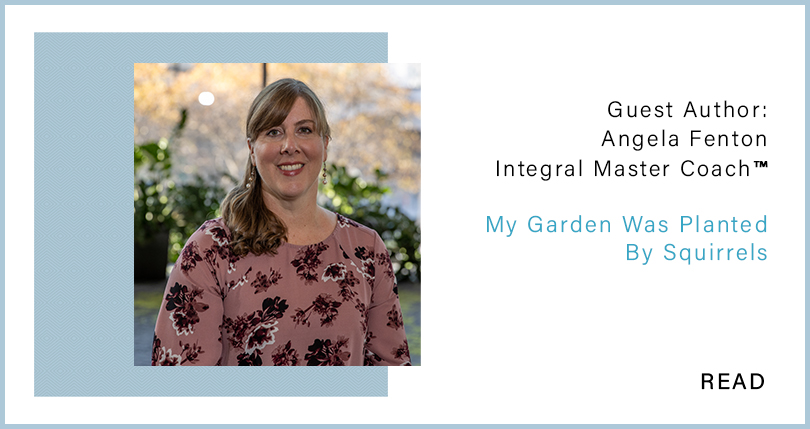
Angela Fenton is an Integral Master Coach™ and founder of Concentric Coaching, where she helps leaders, teams, and organizations grow from the inside out. Drawing on 20 years of corporate leadership experience, she brings warmth, insight and practical challenge to help people navigate change.
f you’ve ever planted tulips, you’ve likely also noticed that, over the years, they seem to move around. Some disappear. Others shift to the middle of the lawn. Others become clustered together in places you don’t quite remember planting them. One year, several of my tulips ended up in my neighbour’s garden, while her raspberries and Johnny Jump-Ups left her garden and appeared in mine.
As I sit here reflecting on how my coaching practice has evolved over the past few years, it’s clear to me that the squirrels, birds, and bees have had more of a say in how my garden has taken shape than I’ve given them credit for. And I’m so glad they have.
Like the gardener looking at a brand-new raised bed full of rich soil and imagining the possibilities, there’s a moment where many of us begin to form a picture of the coach we’re going to become and the practice we’re going to create. It’s often a beautiful picture. Clear. Purposeful. Full of promise.
We imagine who we’ll serve, the kinds of conversations we’ll have, the impact we’ll make. We start to sketch out what a “successful” coaching practice will look like, and we begin trying to live into that image. I certainly did.
Whether we are imagining a coaching practice, a new direction in our career, or a different way of contributing through the work we already do, it is natural to form a picture of where we believe the path should lead.
When I was completing my MCM training with Integral Coaching Canada, I had a very specific vision in mind. I would build a practice rooted in one-on-one coaching with high-achieving professionals. People who were driven, capable, and striving for their next level. That felt clean to me. Focused. Aligned with how I understood my strengths and the kind of coach I wanted to be.
During my training, the metaphor of being a patient gardener became a way of seeing and working with my own development. I imagined myself planting seeds, tending the soil, nurturing growth, and trusting that, over time, something beautiful would emerge. It was a meaningful shift for me. I was learning to loosen my grip, to trust the process, and to develop the patience that coaching asks of us again and again.
I would plant seeds far and wide across my network and patiently wait to see what bloomed. It was a compelling vision. And, as it turns out, it was also incomplete.
About a year after I finished my training, I was explaining coaching to a close friend of mine, a labour lawyer. I was describing how I work, what clients bring, and what becomes possible in the space of coaching. He listened carefully and then suggested referring someone to me. One of his corporate clients had a leader who had found himself in serious difficulty at work.
I declined almost immediately. This did not belong in my garden. I wasn’t interested in working with “problems.” I wanted to work with high performers who were reaching for something more, not leaders who were trying to recover from something that had gone wrong.
My friend didn’t push, but he also didn’t let it go. He encouraged me, gently but persistently, to at least have a conversation. To meet the organization. To listen, and to stay open. Reluctantly, and probably a bit sulkily, I agreed.
Looking back, I can see that this was one of those moments where my training began to work on me in a way I hadn’t expected. One of the gifts of my work with ICC was learning to recognize my own patterns, especially when they reappeared in more subtle forms. I had become more patient, certainly. But my patience still had conditions. Underneath it was still a desire to control what belonged in the garden. I was willing to wait for the seeds I had planted to grow. I was much less willing to welcome the seeds that arrived from somewhere else.
The leader I met was not what I had imagined. He was thoughtful, self-aware, and deeply committed to doing better. Yes, he had made mistakes that had deeply impacted working relationships, but what stood out was his willingness to look at himself honestly and to do the hard, uncomfortable work of growth.
His dedication was extraordinary. His courage, even more so. Working with him stretched me as a coach in ways I hadn’t anticipated. It invited me into deeper territory. It required me to hold complexity, to stay present when things were messy, and to trust the coaching process in a new way. It opened a door I didn’t even know I had been holding closed. I began to understand more fully why developing the coach as a person is inseparable from developing the coach’s capability.
So much so, in fact, that I gave a talk at a national workplace investigations conference last month about how coaching, under the right circumstances, can be an appropriate primary intervention. I don’t know that I would have said that five years ago.
Since then, I’ve never turned down an initial conversation because it didn’t match my idea of what my practice “should” be. I don’t say yes to every opportunity, but I listen to every one. I stay curious, and that single shift expanded my practice more than any strategic plan I could have created.
The same friend, the lawyer, came back to me later with another suggestion. Many of his clients, he said, were dealing with conflict within teams. After investigations or difficult situations, relationships were strained and often left unrepaired. Had I ever considered training in team coaching?
Again, I felt my spine stiffen and my heels dig in. This wasn’t part of my vision. I was a one-on-one coach. That was the identity I had built in my mind. Team coaching felt like a departure, maybe even a dilution of what I wanted to do.
But thankfully, there was another voice alongside that resistance. A practical, curious part of me that wondered what might be possible. What impact could I have if I worked not just with individuals, but with the systems they were part of? Leading teams had been my career before stepping into coaching, so there was some familiarity there. Still, it asked me to stretch beyond the edges of the practice I thought I was building. I followed the suggestion.
That decision also widened my practice in ways I couldn’t have predicted. My practice grew because my capacity grew. I could see more, stay with more, and respond with greater courage. It allowed my network and organizations to engage me differently. It made professional development more accessible across broader teams and groups. It created new pathways for word of mouth and allowed me to practice working in spaces of both tension and cohesive growth. It also changed how I understood my role as a coach, not just as someone who works with individuals, but as someone who can support the health of relationships and systems.
And then there was a third moment. I was attending an event for nonprofit leaders where speaker after speaker shared a similar theme: Executive Directors in the nonprofit sector are often deeply alone at the top. The weight of responsibility, the complexity of their roles, and the lack of true peer connection leaves many of them isolated and burned out.
I remember leaning over to a friend of mine, who is an Executive Director, and asking, “But what if they didn’t have to be alone?” The idea came almost fully formed. What if I created a space where they could come together, not to perform or present, but to connect? To be supported. To think and feel out loud with others who truly understood their reality?
I asked her if she would join something like that, and she said yes immediately. Then two others at our table said yes as well. And a fourth said yes in the parking lot on our way to our cars. That was the beginning of my first coaching circle for nonprofit leaders. Today, I have multiple circles running, with more planned. It has become one of the most meaningful parts of my work. And it was never part of the original vision I held for myself as a coach.
When I think about it now, my own journey as a coach has unfolded in a way that feels very similar to the development we explore through ICC training. At the beginning, I had a vision of who I was becoming. That vision was important. It gave me direction. It helped me begin. But it was also shaped by the very patterns I was learning to see more clearly. I thought I was becoming a patient gardener, and I was. But I was also still a gardener with a plan.
What changed over time was not just my practice, it was my relationship to control. I became more able to notice when resistance was information rather than instruction. I became more willing to pause before pulling something out by the roots. I became more trusting of the possibility that growth might arrive in forms I had not chosen and could not yet recognize.
My ICC training did not give me certainty about every opportunity that came my way, it gave me something far more useful. It gave me experiences of working with uncertainty. It helped me notice when an old way of seeing was narrowing my options. It helped me ask better questions of myself: What am I assuming? What am I protecting? What might be possible here that I can’t yet see?
Those questions gave me the courage that lets you take the meeting, explore the referral, follow the invitation, or try the thing that doesn’t yet fit the shape of your plan. The patient gardener metaphor still feels true, and it has evolved.
What I didn’t fully appreciate at the time is that I am not the only one planting seeds in my garden. Opportunities, ideas, referrals, and invitations arrive from other people, the squirrels and birds and bees of my life, if you will. These offerings arrive unexpectedly. Sometimes inconveniently.
Sometimes disguised in ways that don’t immediately appeal to me. Each one is a seed, and I get to choose what to do with it. I can pull it out because it doesn’t match what I thought my garden should look like. Or I can allow it to take root, at least for a while, and see what it becomes.
Not every seed needs to stay. Discernment matters. Boundaries matter. And openness matters too.
You may have your own version of the garden. A picture of the coach, leader, practitioner, or person you believe you are meant to become. That picture may be important. It may give you direction and help you begin. It may also be incomplete.
Your plan, your vision, can give you direction. It can also narrow what you are willing to see. The challenge is to notice when you are holding too tightly to the garden you imagined, rather than responding to what is actually beginning to grow. That requires curiosity, discernment, and the courage to consider possibilities you never expected.
As you consider your own garden, ask yourself:
What might you be dismissing because it does not match the garden you imagined?
Where might your resistance be asking you to notice?
What has already begun growing that you have not yet fully recognized?
Then choose one thing you are willing to meet with more curiosity. Stay with it a little longer. Ask what it might need from you before deciding whether it belongs.
The garden I have today isn’t the one I imagined at the beginning. It grew through a mix of intention, invitation, patience, and surprise. It is richer, more diverse, and more alive than anything I could have planned on my own.
I still plant with care. I still tend the soil. I still pay attention to what needs pruning, protecting, or moving into better light. But I am slower now to assume that I know everything that belongs here.
And I find myself deeply grateful for all the hands, wings, and small, persistent creatures that help shape it.
Like it? Share it!