

 Download
 Share
Share
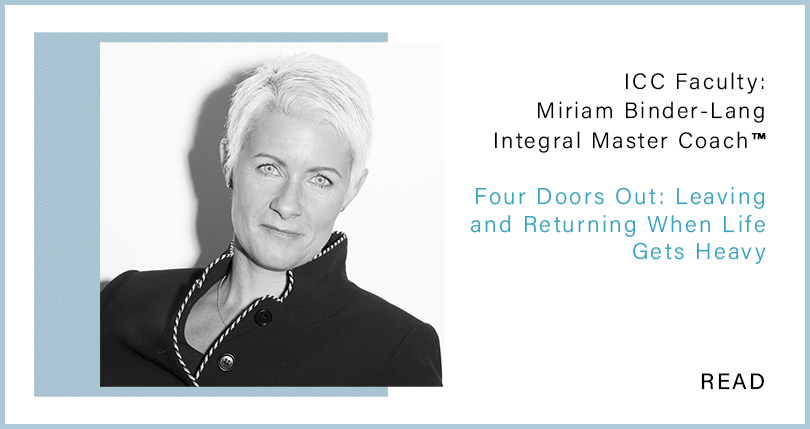

Four Doors Out: Leaving and Returning When Life Gets Heavy
ICC Teacher Miriam Binder-Lang explores how we can use our capacities as escape doors to avoid overwhelming realities, and how those same capacities in order to come back to this moment.
t’s early morning. I’m at breakfast with friends and family. The tea is steaming, and someone says something about the news. Within minutes, we’re ranging across decades, centuries: the fall of empires, the arc of democracies, the long slow grind of history repeating itself. The conversation is rich, sweeping, and alive.
And somewhere in the middle of it, I feel something shift in me. There’s a quiet longing to be somewhere else. Not another city or country, but another vantage point altogether—another planet, perhaps. I want to watch all of this unfold from a distance, somewhere clean and analytical, where none of it can touch me. Part of me longs to study the rise and fall of human systems like an evolutionary biologist studies fossils, with deep interest and no skin in the game. I’m watching empires crumble safely from behind glass. I’m observing, not feeling… I’m not really here.
It takes me a moment to recognize what is happening. I’m leaving. I’m retreating into the detached perspective of the systems analyst, losing myself in the patterns and structures of the collective, using the grand historical narrative as a kind of escape hatch from the felt reality that what happens out there will land in my life, in my relationships. The abstraction is seductive precisely because it feels so intelligent and considered. But I’m no longer present; I have exited the room.
We All Have a Door
This piece grew out of something I wrote recently about staying grounded when the world keeps pulling the rug out from under us. I explored the automatic patterns that kick in when the news hits hard, and the practices that can help us return to presence. But there is another question underneath this:
When being here becomes difficult, where do you go?
I've come to learn that these withdrawals are not random. We tend to follow a path that often runs through the territory we know best, where we feel most capable and at home.
Through my training and work with Integral Coaching Canada, I learned a simple way of noticing where we go when staying present becomes difficult. Integral Theory describes four interconnected territories of experience. In ICC’s training this is introduced through the four quadrants:
• The individual interior — your inner world of thoughts, feelings, imagination, beliefs.
• The individual exterior — your body, your behaviour, your physiology, your actions.
• The collective interior — shared meaning, culture, the quality of connection between people.
• The collective exterior — systems, institutions, structures, historical patterns, data.
The model is simple, but it gives us a surprisingly useful way to recognize how we leave the present. When reality becomes painful or overwhelming, we often reach for the territory that feels most familiar to us. We think, act, seek company, or try to make sense of the larger pattern. None of these is wrong, but each can become a way of moving away from what is hardest to feel.
These four territories offer a map of the four doors built into the one room we all inhabit: the here and now. However different these exits look, however elegant or busy or social or conceptual the escape, each one is a door out of the present. And each, used with greater awareness, can also become a way back in.
Often, the exit we reach for grows out of a genuine strength. Imagination, action, connection, and analysis are all capacities we need. Under pressure, however, the capacity we most trust can become the place we hide.
Four Exits
Once we begin to recognize these exits, each connected with one of the four quadrants, we have more choice. Based on this map, we can identify and become familiar with the patterns of escape we use. It is a powerful lever to know our tendencies of escape when we really want to stay present in the here and now. We may also choose to step away more intentionally when what we are carrying becomes too much, giving ourselves time to rest and resettle.
The Inner Cinema (the individual interior)
We retreat into elaborate inner narratives, fantasy, philosophical rumination, or into wistful reverie. In the territory of individual inner experience, our own thoughts and imagination can become our exit when the world outside grows too loud.
Exiting through this door can look like catastrophizing: running mental simulations of futures that haven’t happened yet. Or it can look like drifting into imagined alternative realities where things are different, calmer, and more manageable. Either way, the film playing inside our heads has become more compelling than what is in front of us.
The tell-tale sign that you’ve taken this exit is absorption. You realize you’re somewhere deep inside yourself, and the people around you have faded to the backdrop. Often, you notice this only when you surface from such deep absorption, suddenly remembering that there have been people around you all along.
The Getaway Car (the individual exterior)
We can also leave through action. The territory of the individual body and behaviour—what we do, how we move, what we produce—offers its own particular exit. Taking this door doesn't look like withdrawal, it looks like frenzied action, or relentless motion.
When the world gets too loud, I try to outrun the discomfort by filling every hour with tasks, optimizing every system, and staying constantly in motion. If I can cross enough off the list and deal with enough of what is immediately in front of me, perhaps the larger ground-shifting will not catch up. The body becomes an instrument of escape rather than a place I inhabit. Exercise, work, scrolling, or consuming... anything that keeps my nervous system occupied enough to drown out what I would rather not feel.
The tell-tale sign you’ve taken this exit is the exhaustion that comes from not stopping or resting.
The Crowded Solitude (the collective interior)
We can leave while remaining surrounded by people. The territory of shared interior experience and the quality of genuine human connection can be abandoned in two quite different ways.
Sometimes it’s a quiet retreat from depth. We are present in body but not really there, keeping things light and easy, and maintaining the appearance of connection without letting anything of actual substance enter.
At other times, the retreat is noisy and boisterous. The pleasure and energy of being with others can drown out what we don’t want to feel. This can be felt in parties that are somehow lonely, intimacy that doesn't register, or laughter that leaves you feeling more alone when it stops.
The tell-tale sign you’ve taken this exit is the strange hollowness in a conversation or shared experience that looks like connection but isn’t. Something feels slightly off in this exchange. Sometimes we notice after the fact that an important dimension was missing in an exchange.
The View from Nowhere (the collective exterior)
This was my door at that breakfast table and I left by moving into the larger view: economies, political systems, historical trends, and institutional dynamics. For those of us drawn to the territory of observable collective structures, it can be genuinely fascinating, and it can become a very comfortable place to hide.
When I withdraw this way, I begin to analyze rather than feel. I reach for the long historical view, the systemic pattern, and I step into the bird's-eye perspective. There is something almost beautiful about observing human affairs from a distance. The world becomes a complex adaptive system. I become a scholar of it. And in doing so, I quietly exempt myself from being part of it.
The tell-tale sign that you have taken this exit is when intellectualizing replaces experiencing. I become more interested in understanding the situation from a 10,000-foot view than in being present with its weight and pain.
Four Ways Back
Taking one of these four exits doesn’t mean you have a character flaw. They’re all intelligent adaptations and ways we manage what feels unmanageable. The inner cinema, the frenzy of doing, the surface warmth of company, and the analytical retreat all have their place. Sometimes we genuinely need to step back before we can step forward.
The practice is to notice that you have left, recognize the door you took, and choose how you want to come back. That begins with curiosity rather than judgment.
One thing I’ve noticed, both in myself and in the people I work with, is the way back doesn't always go through the same door you left from. Sometimes we exit through the mind and return through the body. Sometimes we leave through the grand sweep of systems and come home through a single moment of human contact.
The next time you notice yourself leaving, pause long enough to name the door. Then ask: what part of my experience have I left behind? Your answer may point you toward the way home.
From the Inner Cinema: Returning to the Senses
If you notice you have retreated into an inner narrative, whether catastrophic or escapist, the way back is sensory and specific. What do I actually see right here, right now? What am I hearing? What is the weight of my body in this chair, the temperature of the air, the texture of what my hands are touching? The present moment is always more specific, more textured, more immediate than any mental narrative about it. Coming back to the senses interrupts the mental loop and returns you to what is actually here.
From the Getaway Car: Stopping
If you notice you have retreated into doing, the way back is through the body Rather than using the body to outrun the pain, try to dwell and inhabit the body fully. This might mean simply stopping, even for a moment, and sitting with the discomfort that all the activity was designed to mask. It might mean the difference between a walk that is a distraction and a walk where you actually feel your feet on the ground, where you notice the air on your skin. The body knows how to come home to itself when we stop using it as a getaway car.
From the Crowded Solitude: One Moment of Contact
If you notice you have retreated from depth—whether into pleasantness or into noise—the way back is through a single moment of genuine contact. Sometimes it just takes one moment where you let what someone says actually land in you. A moment where you risk saying something true or allow another person's reality to be fully felt. Real connection is porous and requires a willingness to actually be affected by the person in front of you.
From the View from Nowhere: Letting It Land
If you notice you have retreated into systems-thinking, the invitation is not to abandon analytical intelligence but to let it be accompanied by the felt sense of your own stake in what you are analyzing. Ask yourself: where does this actually land in my life? What does knowing this ask of me?
Your answer will usually point to something closer and more immediate than the system itself. It may be a conversation you need to have, a decision you have been postponing, or a way you need to show up differently. Choose one small step before the insight becomes another idea you carry at a distance.
Let the historical pattern become personal. Let the systemic insight touch something concrete like a relationship, or a real-life choice. The analysis is not wrong; it just needs to be grounded in the fact that you are not a scholar observing from outside. You are here and this is happening to you, too.
The Room We Return To
What I notice, sitting at that breakfast table, is that the longing to observe from another planet is useful information. It tells me how much I’m carrying and tells me something about the weight of being present in a world that is genuinely difficult right now. I don't need to shame it or fight it; I just need to see it for what it is.
When I’m ready, I can set down my mental telescope and let the conversation stop being a subject of study and become again what it actually is: my friends, my family, this cup of tea, this morning that is my real life. I return to the room, right where I am.
Perhaps presence is not something we secure once and for all. Perhaps it is this repeated willingness to notice that we have left and come back to the life that is actually here.
There is something I find myself quietly grateful for in moments like this: that I’m not having this conversation alone. Around that table, and in students and clients I serve, I see others trying to stay present, catching themselves leaving and finding their way back. That shared practice and ongoing effort, even when it is unspoken, is itself a form of presence. We choose, again and again, to come back to the room.
Like it? Share it!